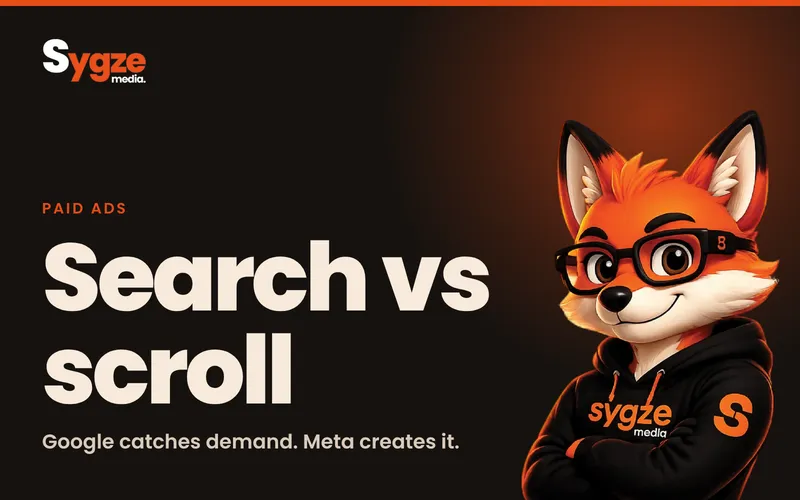
Neither platform is better for every small business. Google Ads usually wins when people already search for what you sell, while Meta Ads usually wins when you need to create demand by showing people something they did not know to look for. Meta clicks and leads are often cheaper, but Google leads often arrive closer to buying, so the cheaper lead is not automatically the better deal. The number that settles it is your own cost per paying customer.
What is the real difference between Meta Ads and Google Ads?
The real difference is intent versus discovery. Google Ads shows your ad to people who are actively searching for what you offer, so they are often close to buying. Meta Ads shows your ad on Facebook and Instagram to people who were not looking, chosen by their interests and behavior, so the creative has to earn their attention.
Google Ads, in its classic search form, shows your ad to someone who has just typed a query such as emergency plumber near me or accountant for small business. That person has a problem right now and is actively looking for a solution. You are bidding to be one of the first answers they see.
Meta Ads, across Facebook and Instagram, shows your ad to people while they scroll. They were not looking for you. Meta uses what it knows about their interests and behaviour, plus signals from your own website and customer data, to put your offer in front of people likely to care. You are interrupting, so the creative has to earn attention in a second or two.
That one difference drives almost everything else:
- Google Ads: captures existing demand. Strong when people search for your product or service by name or category. Text-led, so you compete on relevance, offer and landing page.
- Meta Ads: creates new demand. Strong when your product is visual, impulse-friendly or new enough that people do not search for it yet. Image and video-led, so creative quality decides results.
- Google Ads: you usually pay more per click because the click is closer to a purchase.
- Meta Ads: clicks and leads are usually cheaper, but more of those people are early in their decision and need follow-up.
How much do Meta Ads and Google Ads cost in 2026?
There is no fixed price on either platform. Both run auctions, and what you pay depends on how many advertisers want the same searcher or audience, how relevant your ad is, and how well your page or form converts. Published averages come from other people's accounts and markets, so your own numbers after a few weeks of spend are the ones to plan around.
What drives cost on Google Ads
On Google search you bid on keywords, and the price of a click follows the value of the customer behind it. Searches for high-value, urgent jobs, such as legal, dental or home repair work, tend to cost the most. Lower-value categories, such as food or entertainment, tend to be much cheaper.
- Competition: the more local businesses bidding on the same phrase, the higher the price.
- Ad relevance and landing page quality: a closely matched ad and page can win clicks for less than a vague one.
- Match type and keyword choice: broad keywords bring more traffic but also more irrelevant clicks you still pay for.
Before spending, use Keyword Planner inside a Google Ads account to see estimated monthly searches and the average cost to show for the phrases you care about. That beats any national average.
What drives cost on Meta Ads
On Meta you pay to reach an audience rather than a search. Costs tend to rise in busy retail periods when more advertisers compete for the same feeds, and fall when your creative holds attention.
- Creative quality: strong images and video usually lower the cost of every result because more people stop and respond.
- Campaign objective: a campaign optimised for leads or purchases costs more per click than one optimised for traffic, but should bring better-qualified people.
- Form friction: an instant form with few questions brings more, cheaper leads; a longer form brings fewer, more serious ones.
How to read your own cost per lead
Cost per lead is simply what you spent divided by the number of leads you received. It is a useful early signal, but it can mislead you if you stop there. A Meta lead is often someone who tapped a form while scrolling, and a Google lead is often someone who searched for your service and then chose you. The Google lead tends to need less nurturing.
So take two more steps. Work out how many of every ten leads actually bought, then divide ad spend by paying customers to get cost per customer. A platform with a higher cost per lead can still win if more of its leads close. Compare that figure with what a customer is worth to you over time.
Which businesses do better on Google Ads?
Google Ads works best for businesses people search for when they have a need, often an urgent one: emergency and home services, professional services, clinics, local businesses with near me searches, B2B services, and stores selling products people search for by name. If customers already search for what you sell, Google is usually the place to start.
- Emergency and home services: plumbers, electricians, locksmiths, roofers, pest control
- Professional services people shop for: lawyers, accountants, tax advisers, IT support
- Health and clinics: dentists, physiotherapists, cosmetic clinics, vets
- Local businesses with near me searches: car repair, cleaners, movers
- B2B services and software where buyers search for a category or a competitor
- Ecommerce stores selling products people search for by name or type
Which businesses do better on Meta Ads?
Meta Ads works best when the product sells itself visually, people buy on impulse, or demand has to be created: fashion and beauty ecommerce, restaurants and venues, fitness and coaching, new products few people search for, and real estate or recruitment offers. It is also strong for remarketing to people who already visited your site or engaged.
- Fashion, beauty, jewellery and lifestyle ecommerce
- Restaurants, cafes and venues with offers and events
- Fitness studios, coaches and courses
- New or unusual products that few people search for yet
- Real estate and recruitment, where a simple offer and a short form can bring a steady flow of enquiries
- Any business with strong photo or video content and a clear audience profile
Meta is also strong for remarketing: showing ads to people who visited your site, watched your videos or engaged with your page, so you stay in front of them while they decide.
How should a small business split its first ad budget?
There is no official split, and anyone who quotes one figure for every business is guessing. A sensible approach is to lean towards the platform that matches how your customers buy, and keep a smaller test budget on the other.
- Search-led business (emergency services, clinics, legal, local services): start with most of the budget on Google search, for example around 70 to 80%, and use the rest on Meta remarketing to people who visited your site.
- Discovery-led business (fashion, beauty, food, fitness, new products): start with most of the budget on Meta, for example around 70 to 80%, and use the rest on Google for branded searches and the most direct buying phrases.
- Unsure which way you lean: split roughly evenly for the first six to eight weeks, then move money towards whichever platform shows the lower cost per paying customer.
- Very small budget: pick one platform only. Spreading a small budget across both usually means neither gathers enough data to learn.
Whatever split you choose, set a review point in advance. Decide which number you will judge it on, usually cost per customer or return on ad spend, and give each test enough time to collect meaningful data before you cut it.
What tracking do you need before running ads?
Most disappointing ad results come from broken or missing tracking, not from the platform. Both Google and Meta optimise towards the conversions you report, so if they cannot see your sales or leads, they cannot find more of them.
Tracking for Google Ads
- Conversion tracking set up for the actions that matter: form submissions, calls, bookings and purchases
- Enhanced conversions, which Google describes as using a secure one-way hashing algorithm called SHA256 on your first-party customer data, such as email addresses, to improve measurement accuracy
- Enhanced conversions for leads if you close sales offline, so Google can link a sale back to the ad that produced the lead
- Call tracking if phone calls are a main source of business
Tracking for Meta Ads
- The Meta Pixel on your website for browser-side events
- The Conversions API, Meta's server-side connection, whose events Meta says are processed like events sent using the Meta Pixel
- Deduplication checks, so a lead or purchase is not counted twice when it arrives from both the pixel and the server
- A way to feed back which leads became customers, ideally from your CRM
Tracking that sits outside both platforms
Use UTM tags on every ad link, keep a simple record of where each customer came from, and compare platform-reported results with what actually lands in your bank account or CRM. Platforms tend to give themselves credit generously, so your own records are the tie-breaker.
Meta Ads or Google Ads: which should you choose?
Choose Google Ads first if people already search for your service and each customer is worth a lot. Choose Meta Ads first if your product is visual, few people search for it, or you need a steady volume of enquiries. Once one channel is profitable, use both, and fix your tracking before you spend on either.
- Choose Google Ads first if people already search for your service, especially with urgent or near me phrases.
- Choose Google Ads first if each customer is worth a lot and you can afford a higher cost per lead for buyers who are closer to deciding.
- Choose Meta Ads first if your product is visual and easy to understand in a short video or image.
- Choose Meta Ads first if few people search for what you sell, because you need to create the demand.
- Choose Meta Ads first if you need volume of enquiries and have a fast follow-up process to qualify them.
- Use both once one channel is profitable: Google to capture search demand, Meta to build awareness and remarket to visitors.
- Fix tracking before choosing either, because without it you cannot tell which one is working.
Where Sygze fits
If you would rather not run this yourself, Sygze Media manages Google and Meta ads for small and growing businesses. Ads management is included in the Growth Engine package at $1,899 a month, alongside social content, SEO fixes and a live reporting dashboard. The Market Dominator package is custom-priced and adds attribution and weekly strategy sessions. Ads-only work is quoted per project after a free audit or short call. In every case, your ad spend is paid directly to Meta or Google and is never part of the fee. For details, see the packages page.
Frequently asked questions
Are Facebook ads cheaper than Google ads?
Per click and per lead, usually yes. However, Google leads often come from people actively looking to buy, so the cost per actual customer can be much closer than the cost per lead suggests.
How much should a small business spend on ads to start?
Enough to collect meaningful data on one platform within a few weeks. Check Keyword Planner for estimated costs in your area, or run a short Meta test; if your budget only buys a handful of leads a month, it will not tell you much. Start on one platform, measure cost per customer, then scale.
Can I run Google Ads and Meta Ads at the same time?
Yes. Google captures people who search and Meta reaches new audiences and reminds past visitors. On a small budget, make one channel work before adding the second.
Do published ad cost averages apply outside the US?
Most published averages are based on US campaigns, so treat them as a rough guide at best for the UK, Canada and the GCC. Your own account data after a few weeks is more reliable.
What is the most common mistake small businesses make with paid ads?
Launching without proper conversion tracking. Without it, the platforms cannot optimise and you cannot tell which campaigns bring customers. Setting up conversion tracking, enhanced conversions on Google and the Conversions API on Meta before spending is the single biggest improvement most accounts can make.
If you want a second opinion on which platform suits your business, message Sygze on WhatsApp for a free 10-minute audit.
Sources
- Google Ads Help: About enhanced conversions
- Google Ads Help: Use Keyword Planner
- Meta for Developers: Conversions API